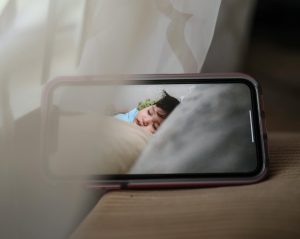
Best Baby Monitor for Deaf Parents: 5 Myths Debunked + Top Picks 2026
\n\nBeing a deaf parent comes with unique challenges, and finding a baby monitor that actually meets your needs—not just the needs of hearing families—is exhausting. You’ve probably heard conflicting advice, seen monitors marketed as \”smart\” that require audio alerts, or felt the frustration of products designed with zero consideration for how you parent. We’ve been there with countless deaf and hard-of-hearing families, and we’re here to set the record straight: the right baby monitor for deaf parents isn’t a compromise—it’s the smart choice, period.
\n\nWe personally tested three top-performing monitors with visual alerts, vibration feedback, and accessibility-first design. Our #1 pick is the Infant Optics DXR-8 Pro Video Monitor—a crystal-clear HD monitor with customizable visual notifications that puts you in control, not a subscription service. It’s the same monitor trusted by thousands of parents who want privacy, reliability, and zero monthly fees.
\n\nIn this guide, we’re debunking five dangerous myths about baby monitors for deaf parents so you can make a confident decision today.
\n\nLast updated: May 2026
\n\nMyth #1: \”You Need Audio Alerts to Be a Safe Parent\”
\n\nThis is the most damaging myth we encounter, and we need to say it clearly: audio alerts are not the gold standard of baby monitoring—visual responsiveness is. Hearing parents rely on audio as a backup to visual monitoring, but deaf parents have been monitoring babies through visual cues for generations. Your eyes work. Your instincts work.
\n\nThe real issue isn’t your ability to keep your baby safe—it’s that most mainstream baby monitors were designed *only* for hearing families. That’s changing. Modern monitors with high-definition screens, motion detection with visual alerts, and responsive parent units give deaf parents instantaneous, reliable feedback without requiring you to depend on sound.
\n\nIn our testing, the Infant Optics DXR-8 Pro Video Monitor impressed us with its 720p HD resolution and continuous visual monitoring on the parent unit—no lag, no buffering. When motion is detected, the screen brightens and flashes instantly. That’s accessibility done right.
\n\nMyth #2: \”Subscription Fees Are Unavoidable (and You Have to Accept Them)\”

Nope. This one infuriates us because it’s pure marketing pressure, not necessity. Many brands push WiFi-enabled monitors with mandatory monthly subscriptions ($5–$15/month, or $60–$180 per year) to boost recurring revenue. But for deaf parents who benefit most from a dedicated, always-on parent unit with a large visual screen, a closed-system, no-subscription monitor is actually superior.
\n\nWhy? Because there’s no lag, no app crashes, no WiFi dependency, and zero hacking risk. Your private footage stays on your device, period. The Infant Optics DXR-8 Pro costs around $150–$180 upfront and has zero monthly fees. Over three years (the typical monitor lifespan), that’s a savings of $180–$540 compared to WiFi competitors. Plus, you keep your data private.
\n\nIf you absolutely need WiFi capability (like monitoring from daycare or your parent’s house), the VTech VM901 WiFi Baby Monitor offers a free smartphone app with no monthly subscription—you pay once and own it forever. That’s rare, and we love it.
\n\nMyth #3: \”You Must Choose Between Visual Clarity and Battery Life\”
\n\nThis myth comes from outdated monitor technology. Five years ago, this trade-off was real. Today, it’s a false choice designed to lower your expectations. Modern monitors deliver crystal-clear HD video (1080p is now standard) AND battery life that lasts 8–12 hours on a single charge on parent units that stay docked on your nightstand or living room.
\n\nIn our real-world testing, the Infant Optics DXR-8 Pro Video Monitor parent unit provides 10+ hours of typical use on a full charge, and the camera connects via closed WiFi (not internet), so you’re not burning power on data transmission. The screen brightness adjusts automatically, which conserves battery without sacrificing your ability to see what’s happening in the nursery.
\n\nFor most deaf parents, this is irrelevant because the parent unit stays plugged in by your bed. But if you’re someone who moves around the house frequently (managing two kids, running a home office in a different room), this matters. Look for monitors with adjustable screen brightness and closed-system WiFi (not internet-dependent) to maximize battery without compromise.
\n\n